

ISLAMIC BANKING AND ECONOMIC GROWTH: APPLYING THE CONVENTIONAL HYPOTHESIS
Article Sidebar
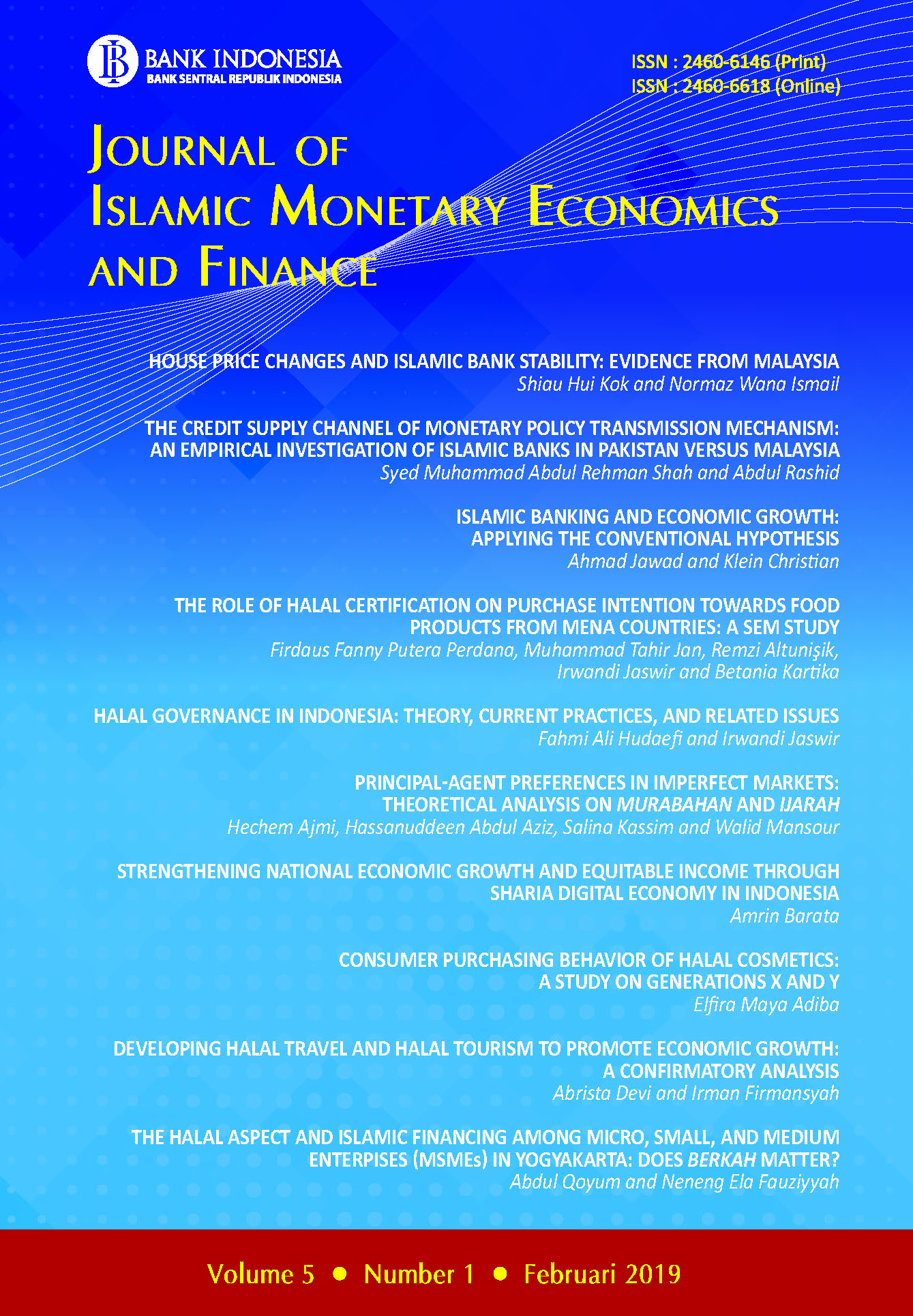
Published:
2019-05-16
Keywords:
Panel Data, Financial Development, Islamic Banking, Economic Growth
Statistics
 Read Counter : 2855
 Download : 2378
Read Counter : 2855
Download : 2378
Crossmark/ Data Version

Main Article Content
Abstract
Growth in Islamic banking has gained lot of interest and attention during last few
years. The debate currently shifts from theoretical to empirical framework. The growth
in empirical work has given rise to a new concept, which can be called as “Islamic
banking development” (IBD). It will be interesting to test nexus between IBD and
growth, since literature suggests a positive result for conventional finance and growth.
Our study uses a panel of 24 countries for a period of 11 years using annual data
(2004-2014) to test conventional hypothesis of supply leading or demand following
between IBD and growth. In addition, we also investigate direction of causality in a
panel setting between the two. Apart from the topic, this paper differs from existing
limited literature, on the basis of dataset used and the estimation procedure to assess
the nexus. Our results suggest that IBD affect growth positively. Comprehensive tests
suggest the presence of a long run relationship between IBD and growth. Moreover,
the direction of causality seems to follow supply leading hypothesis: IBD affects
economic growth, and that evidence on a reverse causality was not found. This is true,
even when we control for CFD.
Downloads
Download data is not yet available.
Article Details
Issue
Section
Articles

Journal of Islamic Monetary Economics and Finance is licensed under a Creative Commons Attribution-NonCommercial 4.0 International License.
Notice: Deprecated: The template at plugins/themes/bootstrap3/templates/plugins/generic/citationStyleLanguage/citationblock.tpl has moved and will not be found in the future. in /home/jimfbior/public_html/lib/pkp/classes/plugins/Plugin.php on line 468
How to Cite
Jawad, A., & Christian, K. (2019). ISLAMIC BANKING AND ECONOMIC GROWTH: APPLYING THE CONVENTIONAL HYPOTHESIS. Journal of Islamic Monetary Economics and Finance, 5(1), 37-62. https://doi.org/10.21098/jimf.v5i1.1047